Cold storage labels rarely fail immediately. Most problems appear weeks after application, after products have been stored, handled, and cycled through real-world cold conditions multiple times. That delay is what makes these failures expensive. By the time a label starts peeling or a barcode stops scanning, the product is already in inventory, workflows are disrupted, and relabeling is the only option.
Most cold storage label failures are preventable. The cause is almost always a specification decision made without fully accounting for what the label would actually face once it left the production floor.
Cold Storage Is More Than Temperature
Temperature gets most of the attention in cold storage label discussions, but temperature alone rarely causes label failure. The real operating environment is more complicated.
When containers move in and out of cold storage, moisture forms on the surface. That condensation migrates to label edges and interacts with adhesives in ways that don’t happen at room temperature. A label that bonds correctly to a dry surface at room temperature may start lifting at the edges after a dozen freeze-thaw cycles because the adhesive was never rated for that combination of cold and moisture.
Handling adds another layer. Cold storage often means gloves, and repeated handling with gloves introduces friction and pressure at the label surface, particularly at edges and corners. Over time that mechanical stress accelerates failures that would have eventually occurred anyway.
Time is the third variable. Cold storage failures are gradual. Adhesives, facestocks, and printed surfaces all change slowly under sustained stress. A label that looks fine at week one may be showing edge lift by week six and fully delaminating by week ten. By then the product has moved through the supply chain and the failure is someone else’s problem to solve.
Cold doesn’t create new problems. It exposes weak assumptions that weren’t tested before the label went into production.
Adhesive Failure: The Most Common Cold Storage Problem
Most cold storage label failures trace back to the adhesive. Adhesives are formulated to perform within temperature ranges, and outside those ranges their behavior changes in ways that cause labels to fail.
At low temperatures, standard permanent adhesives stiffen. Below a threshold called the glass transition temperature, the adhesive loses its viscoelastic properties and becomes rigid. A rigid adhesive can no longer conform to the container surface as the container contracts in the cold, and the bond breaks. The label starts at the edges and works inward.
The specific failure depends on how far below the adhesive’s rated temperature the label is operating. A label with a standard permanent adhesive stored at -20°C may hold for weeks before showing edge lift. The same label at -40°C may fail much faster. The label looks identical in both cases until it doesn’t.
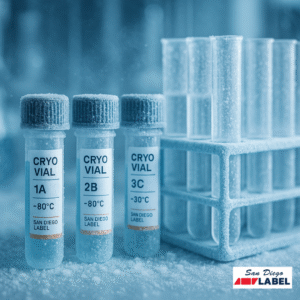
Freezer-grade adhesives are formulated to remain flexible and maintain bond strength at low temperatures. Cryogenic adhesives extend that range further, down to -80°C and below for biotech and pharmaceutical applications. Specifying the right adhesive for the temperature range involved is the single most important decision in a cold storage label specification. Everything else is secondary.
For more on how adhesive selection interacts with facestock and print method in cryogenic applications specifically, see our cryogenic labels guide.
Facestock Failure in Cold Environments
The adhesive gets most of the blame for cold storage label failures, but the facestock matters too. Materials behave differently at low temperatures and not all of them behave well.
Paper facestocks are not appropriate for cold storage applications. Paper absorbs moisture from condensation, weakens, and loses dimensional stability. A paper label in a cold storage environment will degrade regardless of how well the adhesive is performing.
Film facestocks are the standard for cold storage labels, but not all films perform the same way. Some polypropylene films become brittle at very low temperatures, developing small cracks that compromise both the printed surface and the adhesive bond underneath. Polyester film maintains dimensional stability and flexibility across a wider temperature range, which is why it’s the preferred facestock for applications that reach -80°C and below.
Brittleness is particularly problematic for labels on curved surfaces. A film that becomes rigid and brittle at low temperatures can’t maintain conformability on a cylindrical vial or tube. The label begins to spring away from the surface at the edges, and condensation gets under it, accelerating adhesive failure.
Functional Failure vs Physical Failure
Not every cold storage label failure involves a label falling off. In regulated environments, a label that stays on but becomes unreadable has still failed. This distinction matters and it’s one of the most commonly overlooked aspects of cold storage label specification.
Condensation on a cold container surface can reduce the contrast between printed text and the label background enough to make barcodes unreliable or fine text illegible. A barcode that scans correctly in a dry environment may fail consistently after the container has been in a freezer and then removed into a warm room. The label looks intact. The barcode looks intact. But the scanner can’t read it.
This type of functional failure is more common in non-cryogenic cold storage applications than in true cryogenic ones. Cryogenic labels typically use opaque purpose-built facestocks with high contrast printing. Non-cryogenic cold storage labels are more often applied to clear or translucent containers where print construction decisions, including contrast, white ink layers, and finish choice, directly affect long-term legibility under real conditions.
Testing for functional failure means checking readability and scan reliability after the label has been through actual storage conditions, not just checking that it’s still physically adhered to the container.
Cryogenic Labels vs Cold Storage Labels
These two categories get used interchangeably and they aren’t the same thing. The distinction matters for specification.
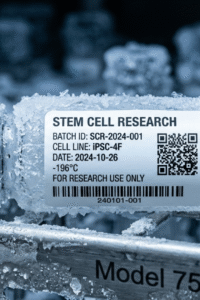
Cryogenic labels are purpose-built for extreme low temperature applications, typically -80°C and below for ultra-low freezer storage and down to -196°C for liquid nitrogen. They use facestocks and adhesives specifically formulated and validated for those conditions. Failures in cryogenic applications are almost always adhesive or material brittleness issues, not print or design issues.
Cold storage labels cover a broader range of applications that involve low temperatures without reaching cryogenic levels. Refrigerated food and beverage storage, standard freezer environments, cold chain distribution. The temperature demands are less extreme but the combination of temperature, condensation, freeze-thaw cycling, and handling creates a set of conditions that standard labels handle poorly and that cold storage specific materials handle well.
The right question to ask when specifying either type is what the label will actually face, not what category it belongs to. A label for a product stored at -20°C in a commercial freezer and handled daily has different requirements than a label for a biotech sample stored at -80°C and rarely touched. Both are cold storage applications. Neither is served well by the same specification.
How to Specify Cold Storage Labels Correctly
A cold storage label specification that starts with the visual design and works backward to the material is a specification built on assumptions. The right order is the opposite.
Start with the environment. What is the minimum temperature the label will face? Will the container cycle in and out of cold storage or stay at a constant temperature? Is condensation expected during those transitions? How long does the label need to perform? What material is the container and what is its surface energy?
Those answers narrow the adhesive options first, then the facestock options, then the print and finish decisions. Each layer of the specification builds on the one before it. A facestock rated for -80°C paired with a standard permanent adhesive is not a cold storage label. The full construction has to be matched to the conditions.
The other variable that gets overlooked is application temperature. Adhesives form their initial bond at the temperature they’re applied at. A cold storage adhesive applied to a container that’s already been in a freezer is forming its initial bond in conditions it may not be designed for. Labels should be applied at room temperature whenever possible, then moved to cold storage after a dwell period that allows the adhesive to fully wet out and form a complete bond.
Diagnosing a Cold Storage Label Failure
If labels are already failing in cold storage, the fix starts with isolating which variable is causing the problem.
The temperature range is the first thing to check. Confirm the actual minimum temperature the product is reaching, not the nominal storage temperature. Freezers in real operating environments often run colder than their rated temperature, particularly in older equipment or at the back of the unit away from the door.
The container material is the second variable. Low-energy surfaces like polyethylene and polypropylene require aggressive adhesives to bond correctly at any temperature. In cold storage, an adhesive that’s borderline on a low-energy surface at room temperature will fail faster than the same adhesive on glass.
Application conditions are the third variable. Labels applied to containers that were already cold, wet, or contaminated at the time of application will fail faster than the same labels applied to clean, dry, room-temperature surfaces. If the application process can’t be controlled, the adhesive specification has to account for less-than-ideal conditions.
If the adhesive, facestock, and application conditions all check out, look at the print and finish. A finish that’s incompatible with the facestock or an ink system that doesn’t bond correctly to the substrate can cause functional failures independent of the adhesive.
Most cold storage label failures can be traced to one of these inputs. The fix involves adjusting the specification, not reprinting the same label on the same material.
How San Diego Label Approaches Cold Storage Applications
When a cold storage label job comes in, the first questions are about the environment, not the design. Temperature range, container material, application conditions, storage duration, and whether the product cycles in and out of cold storage or stays at a constant temperature. Those answers drive the material recommendation.
We can provide cold storage label samples for testing in your actual storage conditions before a production run is committed. For applications at -80°C or below, we’d strongly recommend that validation step before approving a full run. If you’re working through a cold storage label specification or trying to diagnose a failure, contact us here. For more on substrate and adhesive selection for demanding environments, see our complete label substrates guide.