Introduction
Cryogenic labels are engineered for one of the most demanding conditions a label can face: deep freeze storage where standard materials crack, peel, and lose adhesion entirely. Most label failures are gradual — edges lift, print fades, adhesive softens. In cryogenic environments, failure tends to be more abrupt. A label that bonds correctly at room temperature can detach completely once a container drops below the adhesive’s operating range, and in a freezer at -80°C, you won’t see it happening until the label is already off the vial.
This guide covers how cryogenic labels work, what separates a true cryogenic label from a standard durable label, how to specify them correctly, and what to watch for in application and printing. If you’re managing sample tracking in a biotech or pharmaceutical environment, this is the decision that determines whether your traceability system holds up at the temperatures your samples actually live at.
Why Standard Labels Fail in Cryogenic Storage
Understanding why standard labels fail makes it easier to evaluate whether a cryogenic-rated material is actually doing what it claims to do.
Most adhesives are formulated to perform within a moderate temperature range. As temperatures drop, the adhesive’s polymer structure stiffens. Below a threshold called the glass transition temperature, the adhesive stops functioning as a viscoelastic material and becomes rigid and brittle. At that point it can no longer conform to the surface it’s bonded to, and bond strength drops sharply. On a rigid glass vial this means the label peels. On a flexible plastic tube it can mean the label cracks and fragments.
The problem is compounded by freeze-thaw cycling. A sample that goes in and out of a -80°C freezer repeatedly puts the adhesive through repeated expansion and contraction stress. Even an adhesive that holds through a single deep freeze may fail after ten or twenty cycles. In a research environment where samples are accessed regularly over months or years, that cycling is the normal operating condition, not an edge case.
Condensation adds another layer of complexity. When a frozen container is removed from storage, moisture from the air condenses on the cold surface immediately. A label applied to that condensation rather than directly to the container surface has essentially no bond. And a label that was applied correctly but uses a water-sensitive facestock or adhesive can degrade through repeated condensation exposure over time. The Lab Manager’s guide on cryogenic labeling and inventory management covers this failure pattern in more detail if you want to go deeper on the science.
What Makes Cryogenic Labels Different
A true cryogenic label is a matched construction of three components, all rated for the temperature range involved. Swapping one component for a non-rated alternative undermines the whole system.
The facestock needs to remain flexible at cryogenic temperatures without becoming brittle. Polyester film is the most common choice for cryogenic applications because it maintains dimensional stability across a wide temperature range and accepts thermal transfer printing well. Certain polypropylene films are also used, particularly for applications that require conformability on curved surfaces. Paper is not appropriate for cryogenic use under any circumstances.
The adhesive is where most cryogenic label failures originate. Cryogenic adhesives are specifically formulated to remain tacky and maintain bond strength at temperatures as low as -196°C — the temperature of liquid nitrogen. They achieve this through adhesive chemistry that stays flexible below the glass transition temperatures of standard acrylic or rubber-based adhesives. A facestock rated for cryogenic temperatures does not make the label cryogenic if the adhesive isn’t also rated. This is the most common specification error we see.
The print method determines whether the information on the label survives the same conditions the label itself does. Thermal transfer printing is the standard for cryogenic labels because the resin-based ribbon ink bonds to the facestock surface and resists the moisture, abrasion, and temperature stress that cryogenic environments produce. Inkjet printing is generally not appropriate — the ink sits on the surface rather than bonding to it, and it can smear or flake under freeze-thaw cycling and condensation exposure. Direct thermal materials are also not appropriate for cryogenic use because the heat-sensitive coating degrades over time in freezer conditions. The CLIR best practices guide on laboratory sample management outlines why print method selection is treated as a critical variable in long-term sample preservation programs.
Cryogenic Label Performance: Temperature Ranges
Not all cryogenic labels are rated for the same conditions, and the difference matters depending on what your storage environment actually looks like.
-20°C to -40°C covers standard laboratory freezer storage. This range is less demanding than ultra-low temperature storage, and some general-purpose durable labels will perform here — but it’s worth confirming rather than assuming, particularly for long-term storage where freeze-thaw cycling accumulates.
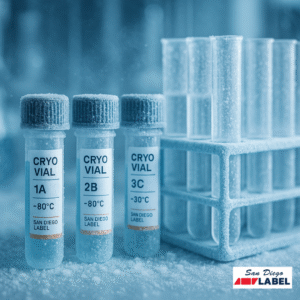
-80°C is the standard for ultra-low temperature freezers used in biotech and pharmaceutical research. This is the range where adhesive selection becomes critical. Labels specified for -40°C will frequently fail at -80°C.
-196°C is liquid nitrogen temperature, used for long-term biological sample preservation. This is the most demanding cryogenic application and requires labels specifically validated for liquid nitrogen immersion — not just rated for low temperatures in general. There’s a meaningful difference between a label that survives -80°C storage and one that survives direct liquid nitrogen contact.
If you’re sourcing cryogenic labels, confirm the temperature rating against your actual storage conditions. A label described as “cryogenic” without a specific temperature rating is an incomplete specification.
Best Practices for Cryogenic Label Application
The label construction accounts for most of the performance equation, but application method matters too. A correctly specified cryogenic label applied incorrectly will still fail.
Apply at room temperature. Cryogenic adhesives are designed to bond at room temperature and then maintain that bond at low temperatures. Applying a label to a cold or frosted surface means the adhesive is being asked to form an initial bond in conditions it isn’t designed for. The surface needs to be clean, dry, and at or near room temperature when the label is applied.
Clean the surface before application. Oils, residues, and condensation on the container surface all reduce adhesion. On glass vials, isopropyl alcohol wiped and allowed to fully evaporate before label application is standard practice. Allow the surface to return to room temperature after cleaning before applying the label.
Allow dwell time before freezing. After application, giving the adhesive time to wet out and form a full bond before the container goes into storage improves long-term performance. The specific dwell time depends on the adhesive, but 24 hours at room temperature is a reasonable standard for applications where long-term cryogenic storage is the goal.
Use wrap-around labels on tubes and vials where possible. A label that wraps fully around a cylindrical container and overlaps on itself is mechanically more secure than one that ends at a free edge. Free edges are where peeling starts, particularly under freeze-thaw cycling.
Print before applying, not after. Printing on a label that’s already been applied to a container introduces variables in print quality that are hard to control. Print, verify, then apply.
Common Cryogenic Label Mistakes
Specifying a durable label instead of a cryogenic one. Durable labels are rated for moisture, abrasion, and general environmental stress. Cryogenic labels are rated for specific low-temperature performance. The two categories overlap in some material characteristics but they aren’t the same thing. A durable label that isn’t rated for cryogenic temperatures will fail at cryogenic temperatures.
Assuming the facestock rating covers the whole label. A polyester facestock rated for -80°C is only one component. If the adhesive isn’t also rated for -80°C, the label isn’t a cryogenic label. Ask for the adhesive specification, not just the facestock spec.
Using inkjet or laser printing for cryogenic labels. Thermal transfer is the appropriate print method for cryogenic applications. Inkjet and laser-printed labels will not maintain print quality through the conditions cryogenic storage involves.
Applying cryogenic labels to cold or wet surfaces. This is the most common application error and one of the most preventable. The surface needs to be clean, dry, and at room temperature when the label goes on.
Not testing before committing to a run. If you’re changing substrates, changing container materials, or moving samples to a new storage temperature range, test the label construction in the actual conditions before running the full quantity. A short validation test is significantly less expensive than a failed run and compromised sample tracking.
Cryogenic Label Applications
Cryogenic labels are used wherever sample integrity depends on label performance at low temperatures:
Biotech and clinical sample vials in ultra-low temperature freezer storage. Pharmaceutical test tubes and storage boxes in -80°C environments. Long-term biological sample preservation in liquid nitrogen. Genomic and diagnostic sample tracking across multi-year research programs. Clinical trial sample management where chain of custody documentation depends on label traceability.
In all of these applications, the consequence of label failure isn’t just a relabeling cost — it’s a traceability gap in a regulated environment, a compromised sample that may represent months of work, or a compliance issue that surfaces during an audit.
How San Diego Label Supplies Cryogenic Labels
We supply cryogenic labels for biotech, pharmaceutical, and research laboratory applications. When a customer comes to us with a cryogenic requirement, the first questions are about the temperature range, the container material and format, the print method, and how the labels are being applied. Those answers determine the material recommendation.
We can provide samples of cryogenic label materials for testing in your actual storage conditions before you commit to a production run. For applications involving liquid nitrogen or long-term storage at -80°C, we’d strongly recommend doing that validation step first. If you’re working through a cryogenic label specification and want to talk through the options, contact us here. For more on substrate selection across temperature ranges, see our complete label substrates guide.