Introduction
The substrate is the foundation of every label. It determines whether the label survives a freezer or fails at the first sign of moisture, whether it holds a barcode through a warehouse environment or smears on contact with a cleaning agent, whether it looks premium on a retail shelf or falls apart in transit.
Most label problems that show up in the field trace back to a substrate decision made earlier in the process — often without enough information about the conditions the label would actually face. This guide covers the most common label substrates, what each one is built for, and how to think through the selection decision before you commit to a material.
Paper Label Substrates
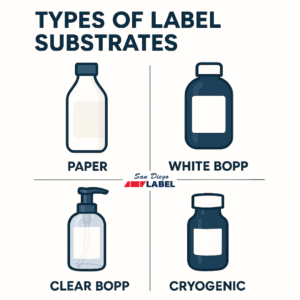
Paper is the most widely used label substrate and the most straightforward to work with. It accepts ink well across digital, flexo, and offset print processes, it’s cost-effective for high volumes, and it’s available in a wide range of finishes — matte, gloss, textured, and uncoated.
The limitation is moisture. Paper absorbs water, and once it does, it weakens, wrinkles, and loses adhesion. That rules it out for anything that will be refrigerated, exposed to condensation, handled with wet hands repeatedly, or used outdoors. It also rules it out for any application where the label needs to survive more than a short to medium service life.
Where paper works well: dry food packaging, retail products with indoor shelf lives, shipping labels for controlled environments, and short-run promotional applications. If the product will stay dry and indoors for its entire life, paper is usually the right call from a cost standpoint.
One practical note on paper selection: the finish affects more than appearance. A matte uncoated paper accepts handwriting, which matters for labels that need to be written on in the field. A gloss-coated paper resists minor surface moisture better than uncoated but still won’t hold up in a wet environment. Adding a laminate overlaminate extends paper label life considerably and is worth considering for any paper application that needs more than basic durability.
BOPP Film Label Substrates
BOPP — biaxially oriented polypropylene — is the most common film substrate in label printing and the go-to material when paper isn’t durable enough but specialty films aren’t required.
The biaxial orientation process stretches the polypropylene in two directions during manufacturing, which increases tensile strength, reduces elongation, and improves dimensional stability. The practical result is a material that resists tearing, holds its shape under mechanical stress, handles moisture without degrading, and prints cleanly across most print processes.
BOPP comes in several variants that behave differently in application:
White BOPP is the most common. It has an opaque white face that prints similarly to paper but with significantly better moisture and chemical resistance. It’s the standard choice for food and beverage labels, personal care products, and consumer goods where durability matters but the look is similar to a paper label.
Clear BOPP is used when the goal is a “no-label” look — where the label appears to be printed directly on the container. This works well on transparent bottles and jars in cosmetics, beverage, and personal care. The tradeoff is that clear BOPP requires more attention to ink opacity and print settings to achieve good color on a clear background.
Matte BOPP gives a soft, flat finish that reads as more premium than gloss in many applications. It’s common in wine, spirits, and specialty food where the tactile quality of the label is part of the product experience.
All BOPP variants share the same core performance characteristics: moisture resistance, tear resistance, and chemical resistance that outperforms paper. The selection between them is driven by the visual outcome you’re after.
Polyester (PET) Film Label Substrates
Polyester film — commonly referred to as PET — is a step up from BOPP in applications that require greater dimensional stability, higher temperature resistance, or more aggressive chemical resistance.
Where BOPP will stretch slightly under tension, polyester holds its dimensions under stress. That matters in applications where the label is applied to a surface that flexes, or where precision is required for barcode placement and scan zones. Polyester also tolerates higher temperatures than BOPP, making it a better choice for labels that will be autoclaved, exposed to steam sterilization, or used near heat sources in an industrial setting.
In chemical environments, polyester outperforms BOPP against stronger solvents and caustic agents. If the label will be regularly exposed to industrial cleaning chemicals, acids, or bases, polyester is typically the more appropriate choice.
Polyimide film — sometimes called Kapton — is a further step up for extreme heat applications. It’s rated for continuous exposure at temperatures that would destroy polyester, and it’s used in electronics manufacturing and other environments where standard materials simply won’t survive.
Cryogenic Label Substrates
Cryogenic labels are engineered specifically for low-temperature storage environments. Standard adhesives stiffen and lose tack at low temperatures, causing labels to peel or fall off entirely. Cryogenic labels use adhesive formulations that remain flexible and maintain bond strength at temperatures as low as -196°C — the temperature of liquid nitrogen.
This matters because the failure mode for a standard label in cryogenic storage isn’t gradual. The label may hold at -20°C, then fail completely at -80°C when the adhesive crosses its glass transition temperature and stops functioning. You won’t see the failure coming from the outside until the label is off the container.
Cryogenic label performance depends on three components being matched to each other:
The facestock needs to remain flexible at low temperatures without becoming brittle. Polyester and certain polypropylene films are common choices.
The adhesive needs to be specifically formulated for cryogenic use. A general-purpose permanent adhesive is not a cryogenic adhesive, even if the facestock is rated for low temperatures.
The print method matters because thermal transfer printing — the most common method for lab labels — can produce variable quality depending on the ribbon and settings used. The printed information has to remain legible after repeated freeze-thaw cycles and after contact with the condensation that forms when frozen containers are removed from storage.
If you’re specifying cryogenic labels, ask your printer which adhesive they’re using and what temperatures it’s rated for. A facestock spec sheet that lists -80°C doesn’t tell you anything about the adhesive performance.
Thermal Transfer and Direct Thermal Substrates
These two categories are defined by the print process rather than the base material, but they’re worth covering because the substrate and print method have to be matched correctly or the label won’t perform.
Thermal transfer printing uses a heated printhead to transfer ink from a ribbon onto the label surface. It produces durable, long-lasting print that resists moisture, heat, and chemical exposure — provided the right ribbon is paired with the right substrate. Thermal transfer labels are standard in logistics, warehousing, pharmaceutical, and industrial applications where barcodes need to remain scannable over a long service life.
Direct thermal printing uses heat-sensitive paper or film that darkens when the printhead applies heat — no ribbon required. The result is a lower-cost, simpler print process, but direct thermal labels are sensitive to heat, light, and chemical exposure. They’ll fade in sunlight and darken if exposed to heat sources. Direct thermal is appropriate for short-term applications like shipping labels, receipts, and short shelf-life food labels where longevity isn’t the priority.
The most common mistake in this category is specifying a direct thermal substrate for an application that needs thermal transfer durability, usually because direct thermal is less expensive. The cost difference disappears quickly when labels fade before the product reaches its end of life.
How to Choose the Right Label Substrate
The selection decision comes down to four questions asked in order:
What environment will the label face? Moisture, temperature extremes, chemical exposure, UV exposure, and mechanical abrasion are the primary environmental factors. Each one narrows the material options. If the label faces multiple conditions — say, cryogenic storage followed by solvent cleaning — the material has to be rated for all of them, not just one.
How long does the label need to perform? Short service life applications — anything from a few days to a few months — can use paper or direct thermal materials in appropriate conditions. Long service life applications, or anything where label failure creates a compliance or safety problem, require film or specialty materials.
What surface is the label going on? Low-energy surfaces like polyethylene and polypropylene containers are notoriously difficult for adhesion. Curved surfaces, textured surfaces, and flexible containers all affect which adhesives will bond correctly. The substrate and adhesive have to be selected together for the application surface, not independently.
What does the label need to look like? Appearance drives the facestock finish decision — gloss, matte, clear, metallic — but it should come after the performance requirements are established, not before. Picking a material for appearance and then hoping it performs is where most substrate specification mistakes originate.
Industry Applications
Food and beverage: White or clear BOPP for most applications. Cryogenic materials for frozen or refrigerated products. Paper for dry goods with short shelf lives and controlled storage.
Biotech and pharma: Cryogenic-rated polyester or polypropylene with matched cryogenic adhesives for freezer storage. Polyester for chemical and solvent resistance. Thermal transfer for serialized barcoding that needs to remain scannable through the product lifecycle.
Industrial and logistics: Thermal transfer polyester or BOPP for barcodes and tracking labels. Polyester or polyimide for high-heat environments. UV-stable films with aggressive adhesives for outdoor applications.
Cosmetics and personal care: Clear or matte BOPP for a premium shelf appearance. White BOPP where full-color printing is the priority. Paper for dry product formats with short retail shelf lives.
How San Diego Label Approaches Substrate Selection
We don’t have a default material we push on every job. The substrate recommendation comes out of a conversation about the product, the environment, the surface, and the service life requirements. For applications where the wrong material has real downstream consequences — cryogenic storage, chemical environments, serialized pharmaceutical labels — we’d rather ask more questions upfront than send samples of the wrong material.
If you’re working through a substrate decision and want a second opinion, or if you’d like samples of specific materials to test in your environment before committing to a run, contact us here.