Choosing the Right Label Finish: Gloss, Matte, Soft Touch, and More
Introduction
Label finishes are the last decision most people make on a label project and one of the first things a consumer notices. Get it wrong and a well-designed label looks cheap, falls apart in the field, or creates production problems nobody saw coming. The decision isn’t complicated once you understand what each finish actually does and what it can’t do.
Gloss Label Finishes
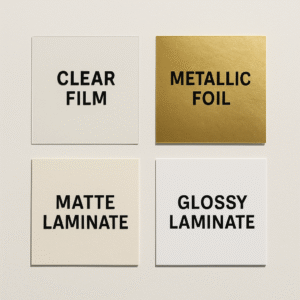
Gloss is the right label finish for most consumer product labels. It makes colors look more saturated, contrast sharper, and the overall label brighter on shelf. Beverages, supplements, and food packaging all default to gloss because it works. The reflective surface also provides solid baseline protection against moisture and minor abrasion when combined with a film substrate like BOPP.
The cases where gloss becomes the wrong choice are specific. Large dark or solid color panels show fingerprints and handling marks clearly on a gloss surface. A label with a deep navy or black background that moves through a warehouse and retail environment before reaching a consumer will look handled before anyone buys it. Gloss also creates glare under overhead fluorescent lighting, which can make fine print harder to read. If your label carries a lot of small regulatory text, that’s worth testing before you approve a proof.
Matte Label Finishes
Matte label finishes don’t shout. That’s the point. The flat, non-reflective surface reads as restrained and considered. In the right category like organic food, skincare, wellness, or craft beverage, that restraint translates directly to premium on shelf. A matte label next to a gloss label doesn’t look inferior. It looks intentional.
Matte handles fine print better than gloss under most lighting conditions because there’s no glare. For compliance-heavy labels with ingredient lists and regulatory disclosures, that’s a functional advantage on top of the aesthetic one.
The honest limitation is scratch resistance. Matte surfaces scuff more visibly than gloss under the same handling conditions. A matte label finish on an uncoated paper stock with no overlaminate going through a rough distribution channel will look rough by the time it reaches a shelf. Pair matte with a film substrate and a protective overlaminate and most of that concern goes away. Matte label finishes also reduce apparent color saturation. If you’re running bright or highly saturated colors, proof on the actual finish before you approve the job.
Soft Touch Label Finishes
Soft touch is the label finish you choose when you want someone to pick up your product and not put it down. The velvety, slightly rubberized feel registers immediately and signals quality in a way that a visual finish alone can’t. It’s why premium spirits, high-end personal care, and limited-edition packaging use it. The tactile experience is part of the brand.
Soft touch laminates resist fingerprints and scuffs well. The texture that creates the feel also means surface marks don’t show the way they do on smooth finishes.
Soft touch has two real limitations that don’t get talked about enough. First, it gets tacky when exposed to moisture or skin oils. A soft touch label on a product used in a kitchen or bathroom will feel unpleasant within weeks. The premium feel becomes a liability. Second, it costs more than standard gloss or matte label finishes, which matters more on a 50,000-unit run than a 2,000-unit specialty project. Use it where the tactile experience genuinely adds value. Don’t default to it because it sounds premium.
UV Label Finishes
UV coating is the most durable label finish available. A liquid coating applied over the printed surface and cured with ultraviolet light creates a hard, glassy shell that outperforms every other finish option on chemical resistance, moisture resistance, and scratch resistance. For cleaning products, industrial containers, outdoor equipment labels, or anything handled regularly in wet or contaminated environments, UV is the right answer.
It also produces the most intense gloss of any label finish. More reflective and visually aggressive than a standard gloss laminate. That’s an asset in categories where maximum shelf impact is the goal. It’s the wrong direction if your brand is going for anything restrained.
Two things to know before specifying UV. It cracks on flexible or squeezable containers. The hardness that makes it so effective on rigid surfaces becomes a problem when the container flexes. Test it on your actual container format before committing. UV-coated surfaces are also nearly impossible to write on. If your labels need to be hand-annotated in the field, this label finish eliminates that option entirely.
Satin and Semi-Gloss Label Finishes
Satin sits between gloss and matte label finishes. Less reflective than gloss, more color-saturated than matte. It’s the right call when neither extreme fits the brand. A full gloss feels too aggressive for some products and a matte finish would sacrifice too much color vibrancy for others. Satin handles variable lighting conditions better than high-gloss and performs similarly for durability. Not the most distinctive choice, but often the most practical one.
What Actually Drives the Label Finish Decision
Most label finish decisions go wrong because they start with aesthetics and treat environment as an afterthought. The right order is the opposite.
Start with where the label is going. Wet environment, UV exposure, heavy handling, flexible container, chemical contact. Each of these eliminates label finish options before brand preferences enter the conversation. A soft touch finish on a refrigerated product is the wrong starting point regardless of how good it looks on a dry sample. A UV coating on a squeezable tube is a crack waiting to happen.
Once the environment has removed the options that won’t work, whatever remains is where the brand aesthetic and budget conversation happens. You’ll still have two or three viable label finishes at that point in most cases. That’s when samples on your actual container format are the most useful tool you have.
We can provide label finish samples on your substrate and container before you commit to a run. If you want to talk through what makes sense for your product, contact us here. For more on how label finishes interact with substrate selection, see our complete label substrates guide.