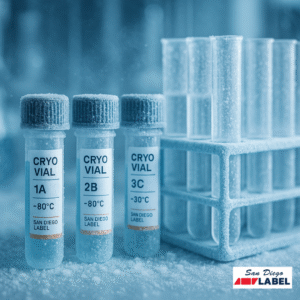
Cryo Vials in freezer rack.
Why Labels Fail in Cold Storage (and How to Prevent It)
Cold storage labels rarely fail immediately.
Most issues appear weeks later—after products have been stored, handled, and exposed to real-world cold conditions.
That delay is what makes these failures costly. By the time they’re visible, product is already in inventory, workflows are disrupted, and relabeling becomes the only option.
Most of these issues are preventable. The key is understanding what actually changes in cold storage and accounting for it upfront.
Cold Storage Is More Than Temperature
Temperature is only one variable. In real-world cold storage environments, labels are exposed to several compounding factors.
Condensation and Moisture
As containers move in and out of cold environments, moisture forms on the surface. Condensation can migrate to label edges and interact with adhesives in ways that don’t occur at room temperature.
Handling With Gloves
Cold storage often means gloves. Repeated handling introduces pressure, friction, and moisture at the label surface—especially around edges and corners.
Time in Storage
Cold storage failures are rarely instant. Adhesives, face stocks, and print all change gradually under stress. Labels that appear fine initially may degrade after extended exposure.
Cold doesn’t create new problems. It amplifies weak assumptions.
The Three Most Common Cold Storage Label Failure Modes
1. Adhesive Mismatch
Adhesives behave differently at low temperatures. Some lose flexibility, some lose tack, and others perform inconsistently when moisture is introduced.
Symptoms include:
-
Edge lift
-
Flagging
-
Partial adhesion failure after storage
This is a material selection issue, not a printing issue.
2. Face Stock and Material Stress
At low temperatures, face stocks can contract or become brittle. Materials that perform well at room temperature may not tolerate cold cycling or prolonged exposure.
This is especially important when labels are applied before freezing and expected to perform long after.
3. Functional Failure vs Physical Failure
Not all failures involve labels falling off.
In regulated environments, a label that remains adhered but becomes unreadable has still failed.
Examples include:
-
Reduced contrast due to condensation or container interference
-
Barcodes that no longer scan reliably
-
Fine text that becomes difficult to read in cold conditions
This distinction matters, particularly for cold storage applications that are not true cryogenic labeling.
How to Specify Cold Storage Labels Correctly
Cold storage labels should be specified based on where they will live—not how they look in a proof.
A capable label supplier should ask:
-
What temperatures will the label experience?
-
Will the container cycle in and out of cold storage?
-
Is condensation expected?
-
What material is the container?
-
How long will the label need to perform?
If these questions aren’t asked, assumptions are being made.
Cryo Labels vs “Cold Storage” Labels
These are not the same thing.
Cryogenic Labels
-
Typically use purpose-built, opaque face stocks
-
Designed specifically for extreme low temperatures
-
White ink layers are usually unnecessary because the label stock itself provides contrast
Failures here are most often related to adhesive performance or material brittleness—not artwork.
Non-Cryo Cold Storage Labels
-
Often applied to clear or translucent containers
-
May rely on print construction for legibility
-
Can experience functional failures even when adhesion is intact
In these cases, print decisions—including contrast and layer structure—can affect long-term usability.
Print and Finish Tolerances Matter More in Cold
Cold storage reduces margin for error.
Small inconsistencies in:
-
Registration
-
Ink coverage
-
Die-cut accuracy
-
Finishing repeatability
can become more visible or more problematic once materials are stressed.
This is why cold storage labeling rewards disciplined, repeatable processes—not one-off success.
A Simple Qualification Checklist
Before committing to a cold storage label, verify:
-
Adhesion after extended cold exposure
-
Readability after condensation
-
Performance after handling
-
Consistency across production runs, not just samples
If a label only works once, it doesn’t work.
If You’ve Already Experienced a Failure
Start by isolating variables:
-
Temperature range
-
Container material
-
Adhesive type
-
Application timing
-
Storage duration
Most failures can be traced back to one of these inputs. The fix usually involves adjusting specifications—not reprinting the same label again.
Final Thought
Cold storage doesn’t create problems.
It exposes assumptions that weren’t tested.
Labels that hold up in these environments are rarely accidental. They’re the result of specifying the environment correctly and controlling variables from the start.