Prop 65 labeling requirements catch a lot of businesses off guard — not because the law is obscure, but because it applies more broadly than most people expect. If you sell products in California, Prop 65 applies to you regardless of where your business is located. That includes e-commerce businesses shipping into the state. And unlike some regulations where enforcement comes from a government agency with limited resources, Prop 65 can be enforced by private citizens and law firms, which means the volume of enforcement actions is significantly higher than most comparable laws.
This guide covers what Prop 65 actually requires, how to determine whether it applies to your product, what compliant warning language looks like, and where businesses most commonly get it wrong. For a broader overview of label compliance across industries, see our Complete Guide to Product Label Compliance.
What Prop 65 Actually Is
Prop 65 is the common name for the Safe Drinking Water and Toxic Enforcement Act of 1986, a California law that requires businesses to provide clear warnings before knowingly exposing anyone to chemicals on a state-maintained list of substances known to cause cancer, birth defects, or other reproductive harm.
The list currently contains over 900 chemicals and is updated regularly by the California Office of Environmental Health Hazard Assessment (OEHHA). It includes industrial chemicals, pesticides, naturally occurring substances, and compounds found in everyday consumer products — everything from lead and asbestos to acrylamide, which forms in certain foods during high-temperature cooking, to DEHP, a plasticizer found in some packaging materials.
The threshold for triggering a warning requirement is low. There’s no minimum exposure level below which the law simply doesn’t apply — instead, OEHHA establishes “no significant risk levels” (NSRLs) for carcinogens and “maximum allowable dose levels” (MADLs) for reproductive toxicants. If your product exposes consumers to a listed chemical at levels above those thresholds, a warning is required. If your product contains a listed chemical but exposure is below those levels, you may be able to sell without a warning — but the burden is on you to demonstrate that, not on the state to prove otherwise.
Who Enforces Prop 65 and Why That Matters
Most federal regulations are enforced by a government agency with finite staff and enforcement priorities. Prop 65 enforcement works differently. The law allows private individuals, advocacy groups, and law firms to bring enforcement actions directly against businesses they believe are in violation. If the plaintiff prevails, they’re entitled to civil penalties of up to $2,500 per day per violation, plus attorney’s fees.
This enforcement structure means that the volume of Prop 65 actions is substantial — thousands of notices are sent to businesses each year, and many are filed by law firms that specialize specifically in Prop 65 litigation. A business that receives a 60-day notice of alleged violation has that window to either come into compliance, reach a settlement, or prepare to defend itself.
For a small or mid-sized business, the cost of defending a Prop 65 action — even one that’s ultimately resolved in your favor — can be significant. That’s the practical reason compliance matters beyond the penalty amounts on paper. The California Attorney General’s Prop 65 enforcement page has more detail on how the enforcement process works.
What Prop 65 Labeling Requirements Look Like
The law requires that warnings be “clear and reasonable.” OEHHA has established safe harbor warning language and formatting requirements that, if followed, satisfy that standard. Using safe harbor language means you’re protected from the argument that your warning was inadequate — which is why it’s worth using the approved language exactly rather than paraphrasing it.
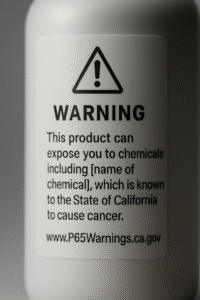
The current safe harbor warning format for most consumer products includes a yellow triangle warning symbol, the word “WARNING” in bold, and specific approved language identifying the chemical and the nature of the risk. The full current safe harbor language and symbol requirements are maintained at p65warnings.ca.gov, which is the authoritative source and worth bookmarking if Prop 65 applies to your products.
For cancer-related chemicals, the standard consumer product warning reads: “WARNING: This product can expose you to [chemical name], which is known to the State of California to cause cancer.”
For reproductive toxicants, the standard warning reads: “WARNING: This product can expose you to [chemical name], which is known to the State of California to cause birth defects or other reproductive harm.”
If your product contains both carcinogens and reproductive toxicants, a combined warning is available.
There are also short-form warnings permitted for small packaging where the full warning doesn’t fit, and category-specific warnings for products like food, alcohol, dental care, and furniture. The category-specific language differs from the general consumer product warning, so if your product falls into one of those categories it’s worth reviewing the specific requirements rather than defaulting to the general language.
Prop 65 Labeling: Font, Placement, and Visibility Requirements
Having the right warning language is only part of compliance. The warning also has to be presented in a way that a consumer can actually see and read it.
Font size must be at least the same size as other consumer information on the label, and no smaller than 6-point type. In practice, if your label carries ingredient lists, usage instructions, or other text, your Prop 65 warning needs to be at minimum that same size. Shrinking the warning to fit it on the label while keeping everything else larger is a common compliance error.
Placement must be such that the warning is clearly visible at the point of purchase. For physical retail products, this typically means the warning appears on the product label or packaging itself. Placing the warning under a flap, on the bottom of the container, or in a location that requires the consumer to actively look for it has been the basis of enforcement actions.
For online sales, the warning must appear on the product listing page — specifically, it needs to be visible to the consumer before they complete the purchase. A warning buried in a FAQ page or accessible only through a link doesn’t satisfy the requirement. This is the area where e-commerce businesses most commonly find themselves out of compliance, because the physical label requirement doesn’t translate automatically to an online listing.
How to Determine If Prop 65 Applies to Your Product
The honest answer is that determining whether your product triggers a Prop 65 warning requirement often requires working with a regulatory attorney or toxicologist who can evaluate your specific formulation against the NSRL and MADL thresholds. That’s especially true for products with complex formulations, food products where chemicals like acrylamide form during processing, or products that contain packaging materials with listed substances.
For businesses that are newer to Prop 65, a practical starting point is to search the OEHHA chemical list for substances you know are in your product or packaging, then assess whether your product could expose consumers at levels above the relevant thresholds. The OEHHA website maintains the full list and the threshold values.
What you want to avoid is assuming that because a competitor isn’t carrying a Prop 65 warning, your similar product doesn’t need one. Enforcement is inconsistent enough that a competitor’s non-compliance isn’t evidence that compliance isn’t required.
Common Prop 65 Labeling Mistakes
Using paraphrased warning language instead of safe harbor text. The whole point of safe harbor language is that it’s pre-approved. Rewording it — even with the same general meaning — removes that protection and opens the door to an argument that your warning was inadequate.
Font too small or warning placed out of sight. Both have been the basis of real enforcement actions. The warning has to be genuinely visible, not technically present.
Forgetting online listings. Physical label compliance and e-commerce compliance are separate requirements. A product that carries a compliant Prop 65 warning on the label still needs that warning visible on the product page before purchase.
Not updating labels when the chemical list changes. OEHHA adds chemicals to the list periodically. A product that didn’t require a warning two years ago may require one now if a new substance was listed in the interim. Reviewing your formulations and materials against the current list periodically is part of ongoing compliance, not a one-time exercise.
Assuming small business size provides protection. Prop 65 includes an exemption for businesses with fewer than ten employees, but it’s narrower than it sounds. If you manufacture the product, distribute it, or have any role in the supply chain beyond pure retail, the exemption may not apply. And if your product is manufactured by a third party and you’re the brand owner, you’re likely still in scope.
How San Diego Label Works With Prop 65
We print Prop 65 warning labels and can incorporate compliant warning language and formatting into your label design. What we don’t do is make the determination of whether your product requires a warning — that’s a regulatory question that belongs with your legal or compliance team.
What we can help with is making sure that once you’ve established what your label needs to say, it’s printed correctly: right size, right placement, right format. If you’re adding a Prop 65 warning to an existing label or building one into a new design, contact us here to talk through the print requirements.