Intro
When it comes to FDA compliance, food packaging is about more than branding — it’s about following strict labeling rules that protect consumers and ensure accuracy. Missing even one requirement can put your product at risk of being pulled from shelves.
In this guide, we’ll walk through the essential compliance steps for food labels so you can design packaging that meets every regulation.
Nutrition Facts Panel and FDA Compliance
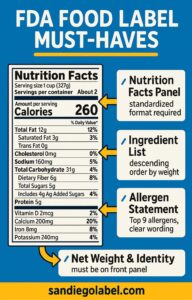
First and foremost, the Nutrition Facts panel must follow the FDA’s standardized format.
-
It must include serving size, calories, macronutrients, and key micronutrients.
-
In addition, the FDA regulates font size, line spacing, and bolding.
👉 In other words, you can’t simply “style” the panel — it must match the official FDA format exactly.
For official guidance, review the FDA Nutrition Facts Labeling Guide
Ingredient List and FDA Compliance Rules
Every food label must include a complete, accurate ingredient list to remain within compliance.
-
Ingredients must be listed in descending order by weight.
-
Common consumer-friendly names (for example, “sugar” instead of “sucrose”) must be used.
As a result, customers can easily identify what’s in your product and avoid confusion.
Allergen Labeling (FALCPA and FDA Compliance)
However, the FDA doesn’t stop at ingredients. Under the Food Allergen Labeling and Consumer Protection Act (FALCPA), manufacturers must clearly declare the Top 9 allergens:
Milk, eggs, fish, shellfish, tree nuts, peanuts, wheat, soybeans, and sesame.
For example, if your product contains casein, the label must include “Contains: Milk.”
Therefore, following FALCPA rules is essential for both safety and full FDA compliance.
Net Quantity & Statement of Identity
Next, your label must display both the net quantity and statement of identity on the principal display panel (PDP) — typically the front of the package.
-
The statement of identity must be easy to read and use the proper font size.
-
The net weight or volume must be clear and in approved measurement formats.
In addition, these details ensure customers understand what the product is and how much they’re purchasing, which supports FDA compliance and consumer trust.
Placement, Readability & FDA Compliance Design Rules
It’s not only what you include — it’s where and how you place it.
-
All mandatory information must appear in a conspicuous, easy-to-read location.
-
Minimum font sizes apply based on packaging dimensions.
-
Labels must stay legible even on curved or irregular surfaces.
Because of this, design reviews for FDA compliance should happen early, especially when working with bottles, jars, or pouches.
Common FDA Compliance Mistakes
Unfortunately, we often see the same compliance errors repeated across brands:
-
Nutrition panel doesn’t follow formatting.
-
Allergen disclosure missing or too vague.
-
Font size too small for net quantity.
-
Ingredient list broken across multiple panels.
As a result, these issues can lead to relabeling, wasted inventory, and regulatory fines.
Final Thoughts
To sum up, getting FDA compliance right is not optional — it’s mandatory. These rules protect both consumers and manufacturers by ensuring accuracy and transparency.
If you’re launching a new product or redesigning your packaging, start with compliance first. That way, you’ll avoid costly reprints and ensure your product stays on shelves.
👉 At San Diego Label, we help food brands create packaging that meets FDA compliance while still delivering strong shelf appeal. Contact us today to learn more!