Introduction
Most label problems don’t show up right away. A label that looks fine when it’s applied can peel in a freezer, smear after solvent contact, or fade after a few months of UV exposure — and by the time that happens, the product is already in the field. In regulated industries, a label that’s no longer legible or intact isn’t just a quality issue. It’s a compliance failure.
Durable labels are engineered to prevent that from happening. This guide covers what makes a label genuinely durable, which environments create the most demanding conditions, and what to look for in material selection before you commit to a run. For a broader overview of label compliance across industries, see our Complete Guide to Product Label Compliance.
Why Label Durability Is a Compliance Requirement
Under OSHA’s Hazard Communication Standard and the GHS framework it’s built on, chemical labels are required to remain legible and intact for the entire service life of the product. The FDA has similar expectations for labels used in lab and clinical environments. The underlying logic is straightforward: a warning label that can’t be read isn’t functioning as a warning.
This matters because durability is sometimes treated as a quality preference rather than a compliance requirement. A buyer might choose a less expensive material thinking the tradeoff is acceptable, without realizing that a label that fails under normal use conditions puts them out of compliance with the regulation that required the label in the first place. The material decision and the compliance decision are the same decision.
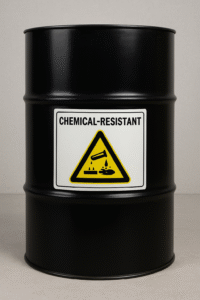
Chemical-Resistant Durable Labels
Labels on solvents, cleaning agents, acids, and lab chemicals face a specific challenge: the substances they’re identifying are often the same substances that will destroy a standard label. Isopropyl alcohol used for surface cleaning, for example, can dissolve certain adhesives and cause label edges to lift. Repeated contact with acids or bases can degrade both the facestock and the printed information on it.
Chemical-resistant durable labels address this through a combination of material selection and surface treatment. Polyester and polypropylene facestocks hold up significantly better than paper in chemical environments. Laminate overlaminates add a protective layer over the printed surface that resists smearing and chemical penetration. Solvent-resistant inks or UV-cured coatings extend the life of the printed information even under repeated exposure.
The right combination depends on what the label will actually contact. A label that performs well against IPA may not hold up against a stronger solvent or a caustic cleaning agent. If you’re specifying labels for a chemical environment, it’s worth being specific about what substances the label will be exposed to rather than selecting a general-purpose durable material and hoping it covers the use case.
Temperature-Resistant Durable Labels
Temperature is one of the most common causes of label failure, and it works in both directions.
On the cold end, cryogenic storage at -80°C or below — common in biotech and pharmaceutical applications — causes standard adhesives to harden, lose tack, and eventually fail. Labels applied at room temperature and then moved to a freezer face additional stress from the dimensional change in the container itself. A glass vial contracts slightly at cryogenic temperatures, and an adhesive that isn’t rated for that range will shear off the surface.
On the heat end, labels used in industrial settings may face autoclaving, steam sterilization, or proximity to heat sources during manufacturing. Standard facestocks can shrink, warp, or delaminate under sustained heat. Adhesives can soften and allow the label to shift or fall off entirely.
Cryogenic-rated labels typically use acrylic adhesives specifically formulated for low-temperature performance, paired with polyester or polypropylene facestocks that remain flexible at extreme cold. High-heat applications often call for silicone-based adhesives or specialized films rated for the temperature range involved. In both cases, the facestock and adhesive have to be matched to each other and to the specific conditions — a cryogenic facestock paired with a standard adhesive won’t perform like a true cryogenic label.
Abrasion and Outdoor Durable Labels
Industrial environments put labels through physical stress that has nothing to do with chemistry or temperature. Labels on equipment, storage containers, or products that move through a warehouse or production floor get scratched, rubbed, and handled repeatedly. Outdoor labels face UV exposure, moisture, and temperature cycling across seasons.
For abrasion resistance, synthetic facestocks outperform paper significantly. BOPP (biaxially oriented polypropylene) is a common choice for applications that need flexibility and tear resistance. Polyester is preferred when dimensional stability matters more — it resists stretching and holds its shape better under mechanical stress. Both materials can be combined with matte or gloss laminate overlaminates that add a sacrificial surface layer, absorbing abrasion before it reaches the printed information underneath.
For outdoor durability, UV-resistant inks and UV-stable facestocks are the baseline requirement. Standard inks will fade in direct sunlight over a period of months. Outdoor-rated materials are formulated to resist that degradation over a much longer service life. The adhesive selection also matters outdoors — surfaces exposed to moisture, heat cycling, and UV may require a more aggressive adhesive than an indoor application on the same substrate.
Tamper-Evident Durable Labels
Durability and security sometimes overlap. In pharmaceutical, biotech, and certain industrial applications, the label needs to do more than survive the environment — it needs to show if someone has tampered with it.
Tamper-evident durable labels combine the physical performance of an industrial-grade material with security features that reveal interference. The most common approaches are VOID-pattern adhesives that leave a visible residue when the label is removed, destructible facestocks that fragment rather than peel cleanly, and sequential seals that span a closure so that opening the package breaks the label visibly.
The material choice for tamper-evident applications has to account for the environment. A VOID adhesive that works correctly at room temperature may not perform the same way after cryogenic storage. A destructible facestock designed for indoor use may become brittle outdoors and fragment prematurely. Testing the tamper-evident feature in the actual use conditions — not just on a benchtop at room temperature — is the only way to confirm it’s working as intended.
Common Mistakes in Durable Label Selection
A few patterns come up repeatedly when labels fail in the field:
Selecting materials based on spec sheets rather than actual use conditions. A facestock rated for -40°C is not the same as one rated for -80°C. A chemical resistance chart that lists general solvent resistance may not cover the specific compound your label will contact. The spec sheet is a starting point, not a guarantee.
Mismatching facestock and adhesive. A cryogenic facestock paired with a standard adhesive will fail at low temperatures. A chemical-resistant film with a water-based adhesive may not hold in wet environments. The entire label construction has to be rated for the conditions, not just the material on top.
Skipping application testing. A label that looks correct in a proof can behave differently once it’s applied to a curved, textured, or low-energy surface and then exposed to the use environment. Testing the full combination — material, adhesive, surface, and conditions — before committing to a production run catches most failures before they become field problems.
Treating durability as a one-time decision. If your product, packaging format, storage conditions, or distribution environment changes, your label spec should be reconsidered. A label that was right for your original application may not be right for an updated one.
How San Diego Label Approaches Durable Label Applications
When a customer comes to us with a durable label requirement, the first conversation is always about the environment. What surface is the label going on? What will it be exposed to, and for how long? What regulatory requirements apply? Those answers drive the material recommendation — not a default “durable label” option that gets applied to every industrial job.
We work with customers in biotech, chemical manufacturing, and industrial production where label failure has real downstream consequences. If you’re specifying durable labels for a demanding environment and want to talk through the material options, contact us here.