Introduction
When labeling products for biotech, pharmaceutical, or laboratory use, durability under extreme conditions is critical. Cryogenic labels are designed to perform where ordinary materials fail — in deep freezers, ultra-low temperatures, and even liquid nitrogen.
At San Diego Label, we supply cryogenic label solutions that keep samples secure and readable, even after years in frozen storage. As a result, researchers can trust their data remains traceable and compliant.
What Are Cryogenic Labels?
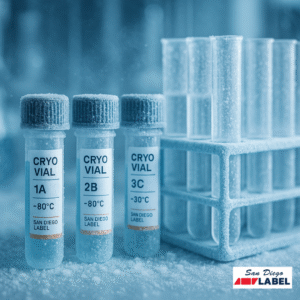
Cryogenic labels use specialty films and cold-resistant adhesives that survive temperatures as low as –196°C without cracking, peeling, or fading. Unlike paper labels, these materials stay intact after multiple freeze-thaw cycles, ensuring text and barcodes remain clear.
In addition, they resist condensation and maintain adhesion on frosted surfaces, which is vital for long-term sample tracking.
For a deeper look into real-world cold storage performance, see Lab Manager’s guide on the crucial role of cryogenic labeling and inventory management.
Why Cryogenic Labels Matter in Biotech and Pharma
Sample Integrity: Label failure can ruin research or break regulatory compliance. Therefore, choosing the right cryogenic construction directly impacts data reliability.
Adhesion in Extreme Cold: Cryogenic adhesives form strong bonds to glass, plastic, and metal, even during repeated temperature shifts.
Legibility: High-contrast printing ensures codes and text stay readable. For this reason, cryogenic labeling is a cornerstone of traceability systems.
Because precision is non-negotiable in life sciences, cryogenic labels have become essential for accurate sample tracking and reliable identification.
Best Practices for Cryogenic Labeling
To get the best results from your cryogenic labels, follow these steps carefully:
-
First, apply labels at room temperature for the strongest initial bond.
-
Next, use thermal transfer printing for barcodes and variable data, since inkjet printing can blur in cold environments.
-
Additionally, add a laminate layer for extra protection if samples are handled or transported frequently.
-
Finally, store labeled vials upright to reduce moisture buildup.
Common Applications of Cryogenic Labels
-
Biotech and clinical sample vials
-
Pharmaceutical test tubes and storage boxes
-
Long-term freezer storage in research labs
-
Genomic and diagnostic sample tracking
Each use depends on reliable performance in extreme cold where other label materials fail.
Conclusion
When temperatures drop, ordinary labels can crack, peel, or lose print quality. Cryogenic labels maintain adhesion, clarity, and durability — protecting both your data and your research.
At San Diego Label, we help biotech and pharmaceutical teams choose the right label construction for any condition, from room temperature to liquid nitrogen.
👉 Need sub-zero label performance? Contact San Diego Label to request your samples today.!