San Diego Label converts RFID labels for two kinds of work that look different on paper and use the same construction: biotech and campus labs, and CPG brands under retail RFID mandates. Inlay, facestock, and adhesive as one label.
A barcode has to be seen. An RFID tag can be read through a carton of vials, a kit shipper, or a sealed case of finished goods if the construction is right. Liquid, metal, and cold change the read. Inlays have their own clock. Do not treat RFID as a standard reprint.
For the converted label, see RFID labels and biotech labels.
RFID in biotech and campus labs
This is the work we are built for. Sample tubes, kits, racks, and secondary packs that have to stay identified when a barcode cannot be lined up to a scanner. Campus labs and biotech plants run the same problem: a lot of small units, cold storage, and a reader that has to pick the tag through a box or a wrap.
Tell us the surface (glass, plastic, corrugated) and the environment (cryo, solvent, ambient). We convert custom RFID for:
- Sample and vial tracking
- Kit and secondary-pack ID
- Carton-level reads on lab shipments
- Campus and core-lab inventory that cannot rely on line-of-sight scanning
Cryo and solvent are the RFQ, not a lifestyle brand. We are not your regulatory counsel. We make the physical label perform: the inlay in the right facestock and adhesive, readable and scannable in the environment you spec.
What an RFID label is
An RFID label has three parts:
- The chip. Stores the unique Electronic Product Code (EPC) for that item.
- The antenna. A thin aluminum or copper layout that receives and transmits the radio signal.
- The inlay. The chip and antenna together. A wet inlay includes adhesive and is converted into a pressure-sensitive label with the facestock you spec.
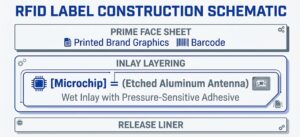
Diagram of RFID construction
RFID in CPG: retail mandates
Consumer packaged goods brands are under a different pressure: retailers who want item-level RFID on incoming shipments, not just a tag on the pallet.
Walmart drove the first large retail RFID programs. In 2003 it asked top suppliers to tag shipping cases and pallets. Tag cost was high, readers were immature, and software could not keep up with the data. The first wave stalled. Many CPG brands paused.
By 2020, tags were cheaper and e-commerce had changed store operations. Walmart restarted with item-level tagging, first in apparel, then electronics, home, sporting goods, automotive, and housewares. Target, Macy’s, and Nordstrom have similar item-level requirements on incoming brand inventory.
Why retailers want item-level RFID
Manual barcode scanning often leaves store inventory in the 65% to 70% accuracy range. Item-level RFID can push that above 98% when associates walk a fixture or backroom with a handheld reader. Buy online, pick up in store only works if the count is real. If the system shows two units and the shelf is empty, the order dies.
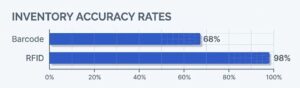
RFID accuracy compared with standard labels
CPG lagged apparel because the pack is harder and the margin is tighter. A few cents on a high-margin garment is easy to hide. The same cents on a $2.50 staple is not. The brand pays for the inlay, the converting, and any line changes. The retailer keeps the labor and stockout savings.
Liquid and metal (labs and CPG)
Ultra-high frequency (UHF) radio bounces off metal and soaks into liquid. That is true in a cryo box and on a shampoo line.
- Metal. Aluminum cans, foil pouches, metal lids, and some lab hardware reflect the signal away from the reader.
- Liquid. Buffers, reagents, shampoos, juices, and detergents absorb energy so the chip never powers up.
Those packs need the right inlay, sometimes a spacer, and a placement that keeps the antenna off the product. Tell us the surface and the fill on the RFQ.
Lead times for RFID labels
Plan the calendar from the inlay, not from a standard label slot. This wait is the same whether the job is a lab kit or a CPG retail mandate.
- Inlays arrive in 55 business days. That is the wait for the RFID inlays themselves.
- Conversion is 10 business days after they arrive. Two weeks of business days to convert inlay, facestock, and adhesive as one label.
Do not treat RFID as a standard reprint. Silicon and inlay supply sit in front of the press. Build 55 business days for arrival, then 10 business days for converting, into launch dates and roll inventory.
| Step | Lead time |
|---|---|
| RFID inlays arrive | 55 business days |
| Convert inlay, facestock, and adhesive | 10 business days after arrival |
What changes on the line
Tension and pressure on a fast applicator can crack a chip. Plan a 1% to 2% fail rate into the run so scrap does not surprise the count.
How to get ready
- Say what the label has to survive. Lab: cryo, solvent, glass, kit pack. CPG: retailer spec, including Auburn University ARC inlay lists where they apply.
- Test on the real pack. Run read-distance tests on filled units, including vials, gel, foil, or liquid consumer goods.
- Put the wait on the calendar. 55 business days for inlays to arrive, then 10 business days to convert, before you need labeled goods.
Converted in San Diego
San Diego Label is an independently owned plant at 4887 Ronson Ct in Kearny Mesa. We convert custom pressure-sensitive RFID labels for biotech, campus labs, and CPG programs: inlay, facestock, and adhesive as one construction.
Send frequency if you already spec it (UHF or HF) and the surface. We will quote the converted label.
Request a Quote · RFID labels · Biotech labels · Government and industrial labels